Be yourself; Everyone else is already taken.
— Oscar Wilde.
This is the first post on my new blog. I’m just getting this new blog going, so stay tuned for more. Subscribe below to get notified when I post new updates.
Be yourself; Everyone else is already taken.
— Oscar Wilde.
This is the first post on my new blog. I’m just getting this new blog going, so stay tuned for more. Subscribe below to get notified when I post new updates.
March 23, 2021
By Christian Gannone
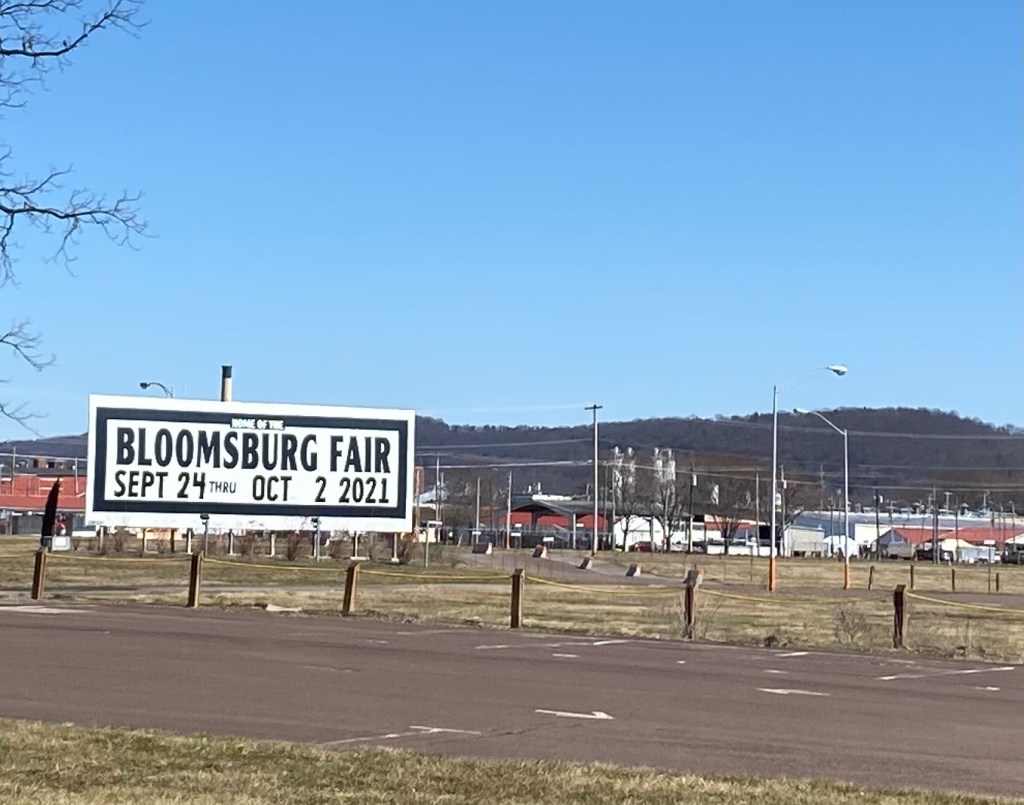
BLOOMSBURG – The Bloomsburg Fair has been a tradition for 165 years, but their consecutive streak has been snapped last year in 2020 when COVID-19 forced the Bloomsburg Fair Association to cancel the fair. The decision was made in concern of public health and safety.
For years, the fair has delivered amusement to the whole state of Pennsylvania and even others who commute from out of state to attend the fair. The fair resides in downtown Bloomsburg which has grown to submerge the fair with the community.
Residents of the town of Bloomsburg and students at Bloomsburg University look forward to the fair each year and take pride in its success. The cancelation of the fair has left the community with emptiness as the fall rolled around this past year.
The Bloomsburg Fair has grown to become one of the biggest amusement attractions in the state of Pennsylvania. In this video from WNEP reporter Julie Sidoni speaks on what the fair usually consists of and what will be missed. Julie Sidoni includes,
“Each year the Bloomsburg fair is responsible for 1,100 vendors, thousands of exhibitors, artists, sponsors and the families who comes to the fair, Sidoni reporter. Instead of hosting the fair this year, the association plans to use the time to make improvements, train staff and look toward the future, said Sidoni”
It has been a disappointment for residents and Columbia county and students at Bloomsburg University.
Over the years, the fair has become an attachment to the university and students look forward to the fun each year.
Bloomsburg University Senior, Michael Porreca shared his thoughts on the situation.
“I’ve gone to the last three fair outing always enjoyed my time there, said Michael. I think it is important for students to connect with the local community, claimed the Senior. The fair has also been a nice escape for students to take a break from school and relieve that stress in the beginning of the semester, but we all missed that this past year,” Michael said.
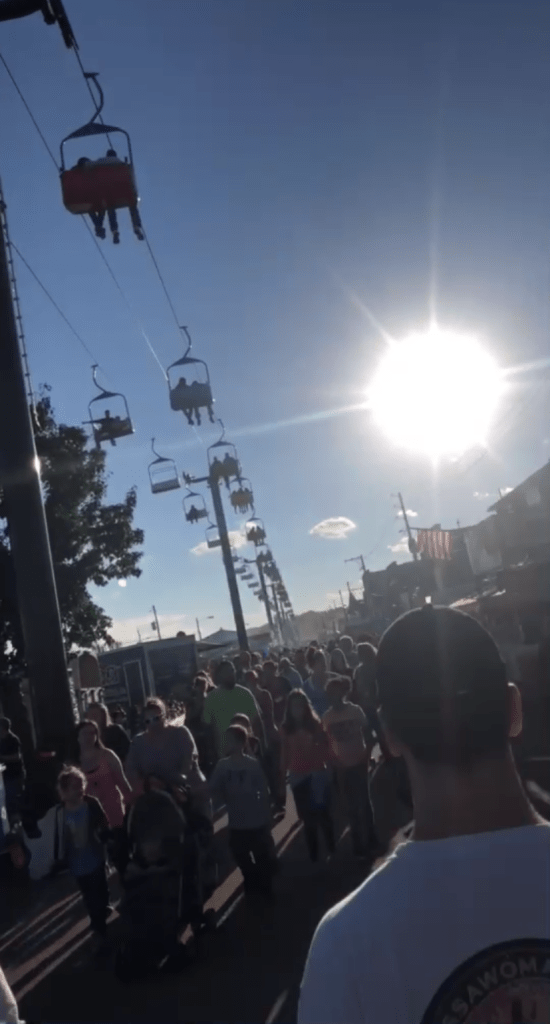
For more from students, check out this video of a firsthand experience of a student traveling through the fair in their last outing in 2019.
According to a WNEP article, Bloomsburg local Judy Stickland says she has attended the fair her whole life.
“Since I was about 2 years old. Now I am 75, so a long time,” Judy Strickland said.
Listen to the full video of interviews with Bloomsburg locals to hear how more people of the community feel about the cancellation and their connection to the fair.
Not only was the community affected by the fair’s absence in their town this past year, the Bloomsburg fair Association was also affected by the community’s absence at their fair.
According to an article from Eyewitness News, reporter Logan Westrope met with the Bloomsburg Fair President Randy Karschner to discuss how the fair has been affected financially with a year off. Randy Karschner stated,
“We are working with the 2019 fair revenue, which had a gross income between $700,000 to $800,000, said President Karschner. Most of that money would have been used to prepare for the 2020 fair in September, Karschner said. But, with it being canceled, we were able to stretch out that money.”
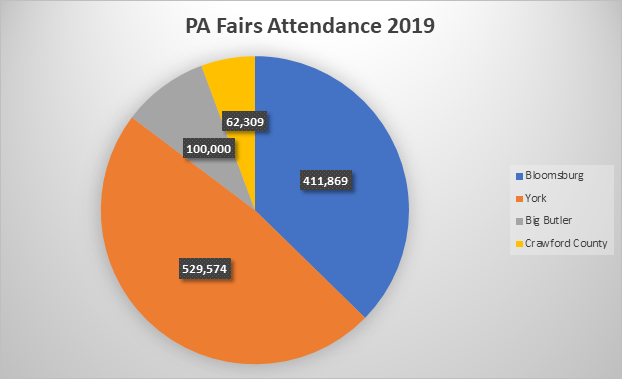
The Bloomsburg Fair is among some of the biggest fairs in the state of Pennsylvania. Their 2019 revenue from admissions compares to a few other popular fairs, who also canceled their fairs in 2020.
The Bloomsburg Fair, The York Fair, The Big Butler Fair, and The Crawford County Fair all charge $8 for general admission.

My article will focus on how the pandemic has affected the Bloomsburg Fair and Bloomsburg University’s community.
I want to include statistics that show how important the fair is to the association and Bloomsburg . For example, I will find out how many people have attended the fair in past years. I want to also try to determine how many of those people were students or Bloomsburg residents. Additionally the amount of vendors and other entertainment services. It would be interesting to find out how far other people travel from out of state to attend the fair. I want to also gain statics on finance. I want to find out how much revenue the fair drives in to see how much money they missed out on during the cancelled year.
I can include all of this information and statistics by using a pie graph. Pie graphs would show where the fairs attention is grabbed the most and least. It would show where their money is most spent and where they drive in more than the rest.
My project will be to investigate how the Bloomsburg Community and the Bloomsburg Fair Association has been affected by the cancelation of the fair in this past year due to the coronavirus pandemic. I think it would be an interesting project for Bloomsburg students and Pennsylvania residents that attend and enjoy the fair annually. I hope to conduct interviews with the Bloomsburg Fair Association, the Bloomsburg Program Board to see their involvements with organizing or advertising the fair, and students who have experienced the fair. I plan to include video and audio in my interviews and footage of the fair grounds.
This video can be a good source of questions I have for the Bloomsburg Fair Association. I have been wondering how a year off will impact them financially and this video provides a good information and that and can be a gateway to follow up research questions.
Bloomsburg Fair Working Financially without 2020 Fair – Bing video
I found this video to be a credible source for an understanding of what the fair looks like in full swing. A first hand view of the fair from a student’s perspective, showing the community at the fair can be useful.
Bloomsburg Fair 2019 preview – Bing video
This article is a more official source on the Fair’s health and safety statement on canceling the fair.
2020 Bloomsburg Fair canceled because of COVID-19 | wnep.com
I found interest in this article and video because it tackles what I plan to discover. The article and video provides interviews on how the tradition ending for a year has affected people and vendors.
The Bloomsburg Fair Association decided to cancel the fair in 2020. The decision was made in concern for the health and safety of the public.
I will be working on a story that discusses how the cancelation of the Bloomsburg Fair has affect the BU community. I have chosen this topic because this past year the students and community of Bloomsburg University, Pennsylvania residents, and all other people who travel from around the country to attend the fair, have been deeply disappointed to hear the announcement of the fair being cancelled due to COVID-19. I myself attended the fair last year and was very excited to attuned it again this year before it was cancelled.
Twitter sources:
BUnow – Bloomsburg University news organization. (1) BUnow (@BUnowcom) / Twitter
Bloomsburg Fair Association – Bloomsburg Fair account. Bloomsburg Fair Association (@Bloomsburg_Fair) / Twitter
WNEP – An ABC news station that covers Bloomsburg area. (1) WNEP (@WNEP) / Twitter
Lisa Washington – journalist Lisa Washington (@LisaWashing) / Twitter
Elizabeth Worthington – journalist Elizabeth Worthington (@ElizWorth16) / Twitter
Chris Keating – journalist (1) Chris Keating (@CKeatingWNEP) / Twitter
Topic 1: How the cancelation of the Bloomsburg Fair has affect the BU community. The Bloomsburg Fair has grown to become one of the biggest amusement attractions in the state of Pennsylvania. The fair attracts over 1,000 vendors including food trucks, games, rides, and even hosts concerts. This past year the students and community of Bloomsburg University, Pennsylvania residents, and all other people who travel from around the country to attend the fair, have been deeply disappointed to hear the announcement of the fair being cancelled due to COVID-19. The cancelation of the fair ended the annual streak of 165 consecutive successful years of fun and entertainment.
This article discusses the traditions and rituals of the Bloomsburg Fair. It provides information about COVID-19 and the toll is has taken on the decision to cancel the fair. It also includes statements from people who run the fair, Governor Wolf (Pennsylvania), and promises a hopeful, bigger, and better fair next year in 2021.
Topic 2: Bloomsburg University plans to return their students to campus for the Spring 2021 semester. Bloomsburg University has developed a COVID-19 plan to bring their students back to Bloomsburg and attend class in person on campus. But first all students must be tested upon arrival. I would like to dive into financial numbers to discover how the much it is costing the university to test students. Also student athletes are expected to be tested more often and may also require testing with the concern of traveling to other universities to compete in their sports.
This page gives an understanding of Bloomsburg University’s COVID-19 plan. Providing information on the plan, university policies, testing and FAQs.
Top 3: How the merge of Bloomsburg, Mansfield, and Lockhaven universities’ will affect Bloomsburg students. Bloomsburg University’s president, Dr. Hanna, has agreed to join Lockhaven University and Mansfield University in a integration of education plan. The plan consist of ways to expand learning opportunities and making college more affordable. The integration will allow students to maintain their identity as a student to their university but have access to the other universities resources.
Lock Haven, Bloomsburg, Mansfield universities merger planned | News, Sports, Jobs – The Express
In summary, Bloomsburg, Mansfield, and Lockhaven will hold their name and athletic programs but will simply open up their academics resources with each other. The calibration and partnership will “enhance responsiveness to workforce-aligned, nondegree, certificate and stackable credentialing programs to meet regional and statewide economic and workforce demands, reinforcing the role that these anchor institutions serve in their communities and the region.” This plan will apply to undergraduates and graduates.
We as a society spend a lot of time on social media. We think we know our followers, we think we know who is following us, but are we really sure? We need to be on our guard more when expressing ourselves over the internet and on social media pages. Social Media is flooded with content from billions of people and not all people have good intentions. People make fake accounts and you dont allows know who is seeing your post or viewing your page. People are always receiving spam and fake messages attempting to hack into accounts. We need to protect our privacy. I believe it starts with having a private account. There is an option with all social media accounts to be private or public, I think there is no reason to be public. You sure do some research on a friend or follow a request before accepting it. Also our social media corporations should do a better job of presenting red flags to us
When we make public posts we are under the impression that our audience is our followers but it is much wider than that. A post on your page may make its way to the “Explore” page which can be seen by anyone not only in the US but anyone around the whole world.
Additionally, when we create accounts we don’t just fill in our name and username, do you ever wonder why your email and phone number is needed? If you google your name your social media accounts will pop up. We need to deselect this option in our setting to keep our information off of search engines. Spammers and cybercriminals can detect your personal information for these search engines.
Lastly, we should not link all of our accounts together. For example when you sign up for different media accounts it asks if you’d like to continue with your Facebook or Google account, this is a simpler and faster way of creating an account so we choose the easy way to do it. But by linking our account all of our content is found much easier by other people and we give our privacy rights away to these websites.
What is media literacy. Well, literacy is commonly known as a person’s ability to read and write. When we use our reading and writing skills towards media content, we can view it as media literacy. It is defined in our class text as, “a set of perspectives that we actively use to expose ourselves to media to process and interpret the meaning of the messages we encounter.” With today’s technology advancements and growing social media world, we as people are constantly viewing media content on a daily basis. Media literacy is being practiced everyday with our emails, texts, social media posts, screen watching etc. Media literacy is present everywhere; from group chats with a few of your friends to worldwide discussion groups, clubs, and movements, small businesses to huge business corporations, local newspapers and radio stations reports to nationwide networks bringing you worldwide politics. We are all connected around the world. With that being said, media literacy goes beyond just reading and writing in the sense that we choose the type of media that we want to expose ourselves to, what we choose not to view, and how we interpret the content we do view, so we all spend our time viewing different media content. Our class text breaks media literacy down into seven different components. “Media literacy relies on Analysis, Evaluation, Grouping, Induction, Deduction, Synthesis, and Abstracting.” We use these seven skills of media literacy to break down the content we view, evaluate the parts that are important or intriguing to us, to make meaning out of the text, and then organize it all and make connections. When talking about media literacy, these skills help develop media into “knowledge structures.” We consume so much media content in a day that we can’t possibly remember everything we see in a day, but our minds go into “automatic pilot” where we filter what we want to take in. After deciding what content to take in and after using the seven skills of media literacy, we then memorize what we consumed to develop these knowledge structures. Our text defines the concept of knowledge structures as “sets of organized information in our memory. We use these patterns as maps to tell us where to get information and also where to go to retrieve information we have previously encoded into our knowledge structures…Information is the key to knowledge structures.”
Social Media has been a part of my life since I was a young kid. It has developed tremendously over the past few decades and I grew up during these advancements so learned to adapt easily. My age generation was exposed to social media from the start of it therefore this generation has developed a label of the social media age group. My first phone was an iPhone and I automatically created social media accounts such as Facebook, Instagram, Snapchat and Twitter. I was instantly connected with all my friends texting in group chats and learning about social media. My generation has progressed to the point to where social media is such an influence in our daily lives that we wake up and go to bed connected with social media and media content. I find myself as an average consumer of media content and social media user, but I also feel that the average person my age uses social media way too much in a day. I couldn’t imagine a single day where I would look at my phone and not see a that I am tagged in a post from one of my friends, or a day where I don’t check any social media updates and send snapchats. It feels as if social media is the core of someone’s life and personality. Nowadays you can almost find out all of someone’s interest, hobbies, and relationship status by just looking and that their social media pages. I know that social media has had some negative impacts on my life. I actually think I spend just amount of time looking at social media content that does not even interest me as I do looking at content that does interest me. There is so much media being drilled at me when I open a social media app that I find myself scrolling past, filtering out so many advertisements and suggested things to follow. Chapter three of our texts refers to this my mind being in “automatic pilot” In the automatic state people are in environments where they are exposed to media messages but are not aware of those messages in the: that is, their mind is on automatic pilot as it filters out of all messages in the environment. This screening out continues automatically with no effort until some element in the message captures their attention.” When I am Social media has strengthened my ability to multitask with media content but has weakened my multitasking ability with real life conversation. For example, I can watch a tv show while sending a text and reading a social media post but if I am doing something on my phone such as scrolling through social media content, my attention is fully drawn to that screen and not interpreting the words coming from a person talking to me. In chapter three of our texts this idea is furthermore exposed. “Thus when you are paying attention to a conversation with your roommate, your attention can be grabbed by a sound or image that pops up on your computer screen and shift that pops up on your computer screen and shift our attention away from your roommate to the screen.” I find this idea to be hypocritical in a way for me because when I am talking to someone and their attention shifts to their phone, I find it to be rude, but I know I am guilty of doing it also.

 Christian's Blog